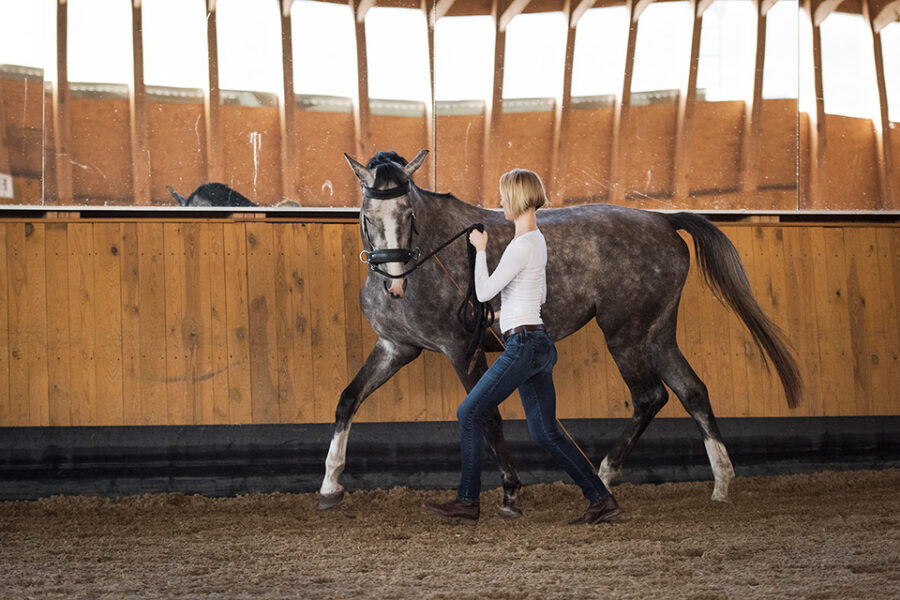
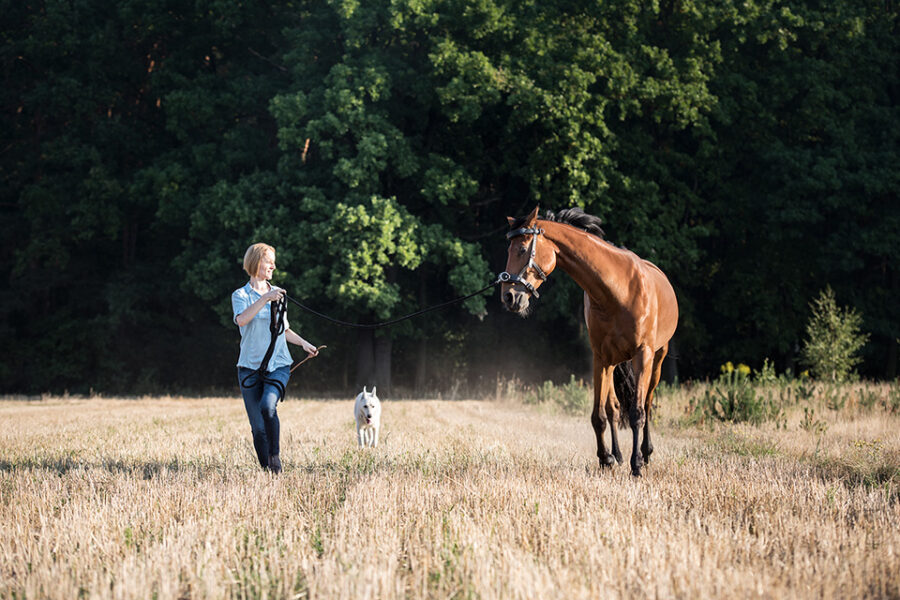
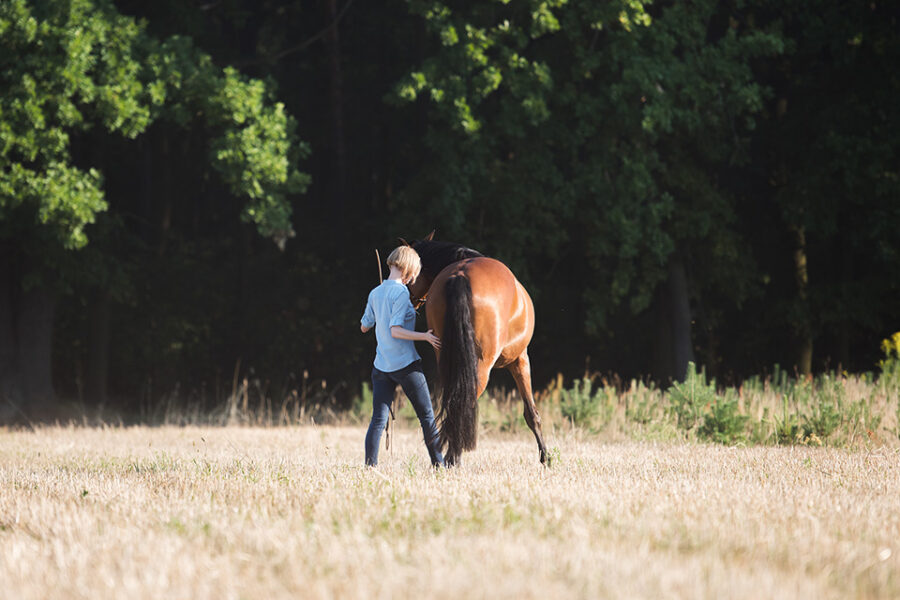
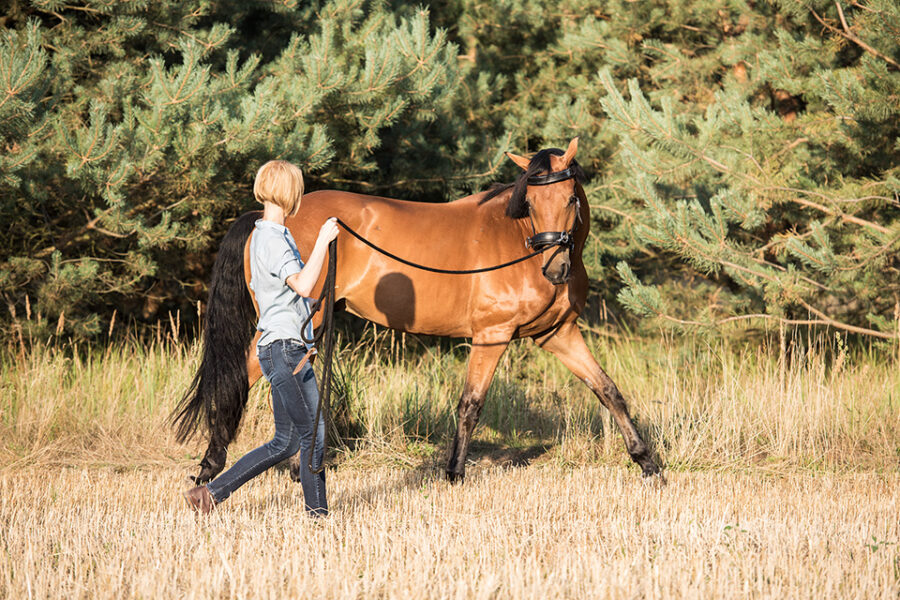
In this module, we begin practicing the same body-to-body connection that we established in walk, but now in trot. The goal is not simply to make the horse trot forward, nor to place the head in a certain position. The goal is to teach the horse how to move in trot with a long neck,
Once the horse is fully warmed up and the horse’s mouth is connected with the rider’s back, we can begin preparing both sides of the horse’s body to relax evenly. This phase of the training is done in walk before moving into trot. Its purpose is to check whether the horse can follow the rider’s
Now that we understand the biomechanics of straightness and the role of relaxation, we can begin applying these principles in practice: The exercises in this module are deliberately (and deceptively) simple. Their purpose is not to make the horse perform complicated movements. Their purpose is to help the rider gradually teach the horse to relax
One of the biggest differences between Anna’s Riding Method and many traditional approaches is that we do not try to straighten the horse by constantly correcting the horse. Many riders spend their entire ride correcting the position of the horse’s shoulders, moving, blocking, or positioning the hindquarters with the legs, adjusting the flexion, changing the
To understand straightness, we first need to understand what we are actually trying to achieve when we straighten a horse. Many riders believe that straightness means making both sides of the horse equal. They spend years trying to strengthen the weaker side, stretch the stiffer side, and create perfect symmetry throughout the horse’s body. At
When I teach riders and ride horses that come to me in training I see over and over again that straightness is one of the most misunderstood concepts in horse riding. Many riders assume that a horse becomes straight when the rider continuously corrects the position of the horse: riders focus on the position of
Another experience that we prepared for you and your dog is the Recall. Normally, recall is based almost entirely on reinforcement. You call the dog, the dog comes, and then you give the dog a treat, toy, or ball. This can work very well in simple situations. However, when the environment offers stronger reinforcement than
Once your dog understands the Stay and Wait exercise built on the basis of Conscious Relaxation, we can move into the heart of this work: Relaxation at Separation Anxiety. When I work with horse owners and dog owners alike, many people say that separation anxiety — not wanting to stay alone without the owner, without
In this Module, we are introducing Conscious Relaxation in the context of restriction, and we begin with the most basic form: restriction of movement. This is very important because in the next module, we will start to introduce Conscious Relaxation in the context of separation anxiety. For that work to become possible, the dog first
In this module, we are going to learn how to introduce two dogs to one another through Conscious Relaxation. Very often, when dogs meet, people expect excitement. They expect pulling, jumping, intense sniffing, rushing toward each other, or immediate interaction. Many people even interpret this excitement as happiness or friendliness. But in this work, we