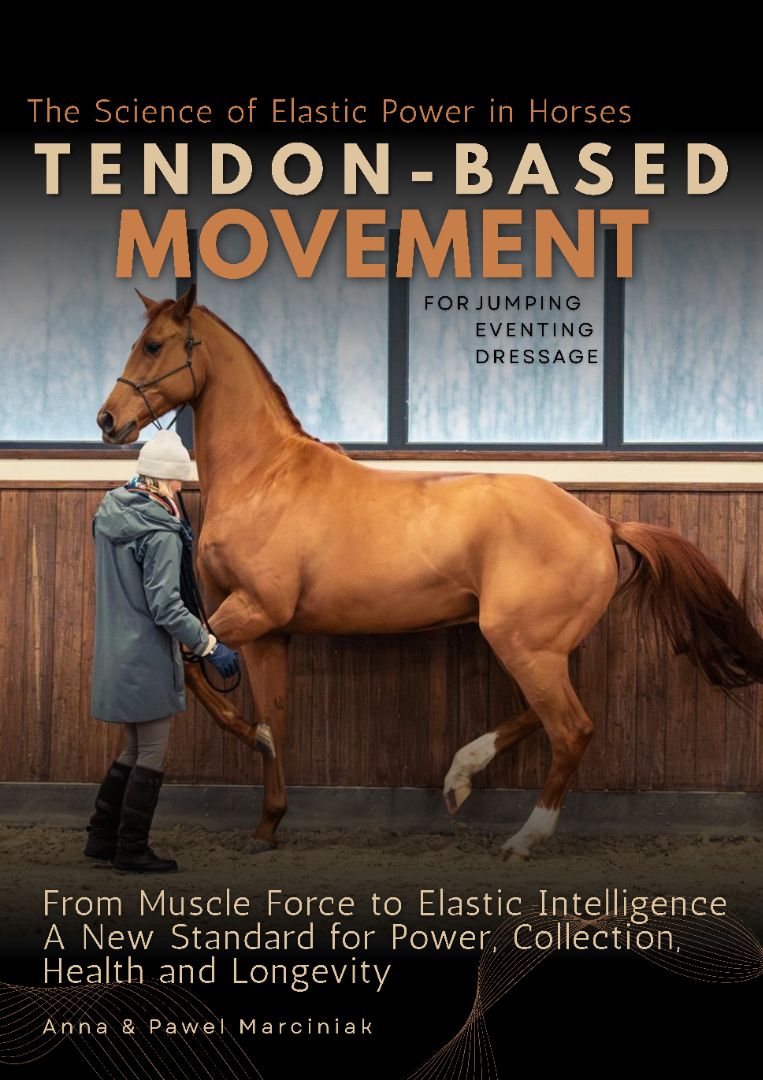
THE BOOK

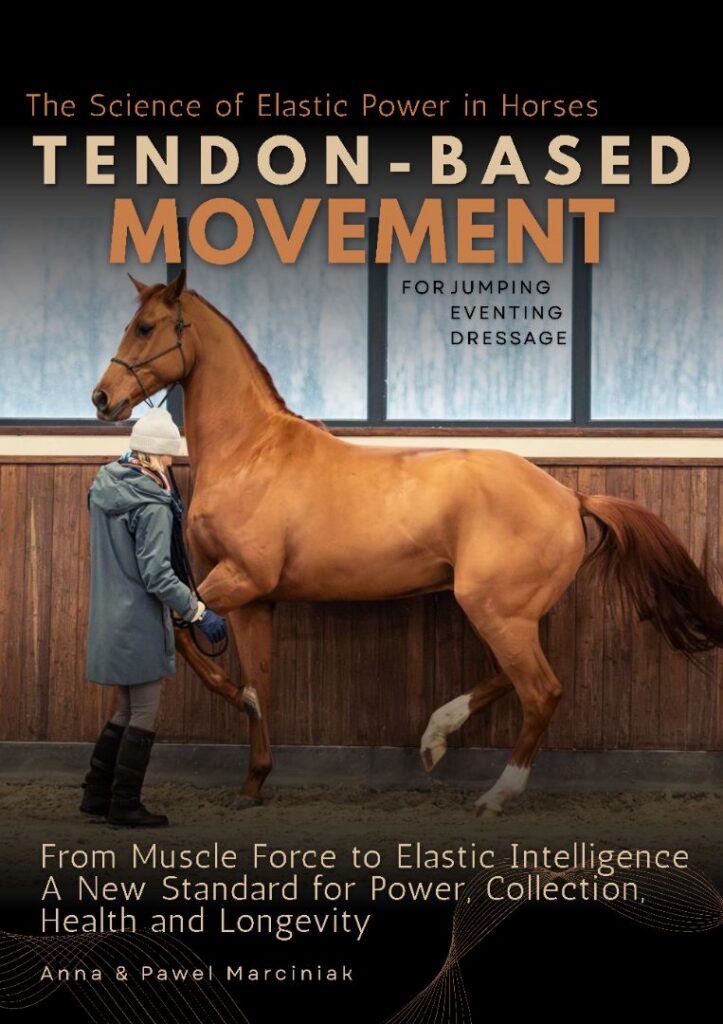
TENDON-BASED MOVEMENT

The Foundation of Elastic Performance

After 300 years of focusing on muscles as the primary generator or movement, we are ready to move forward.

A Biomechanical REVOLUTION of Equine Locomotion

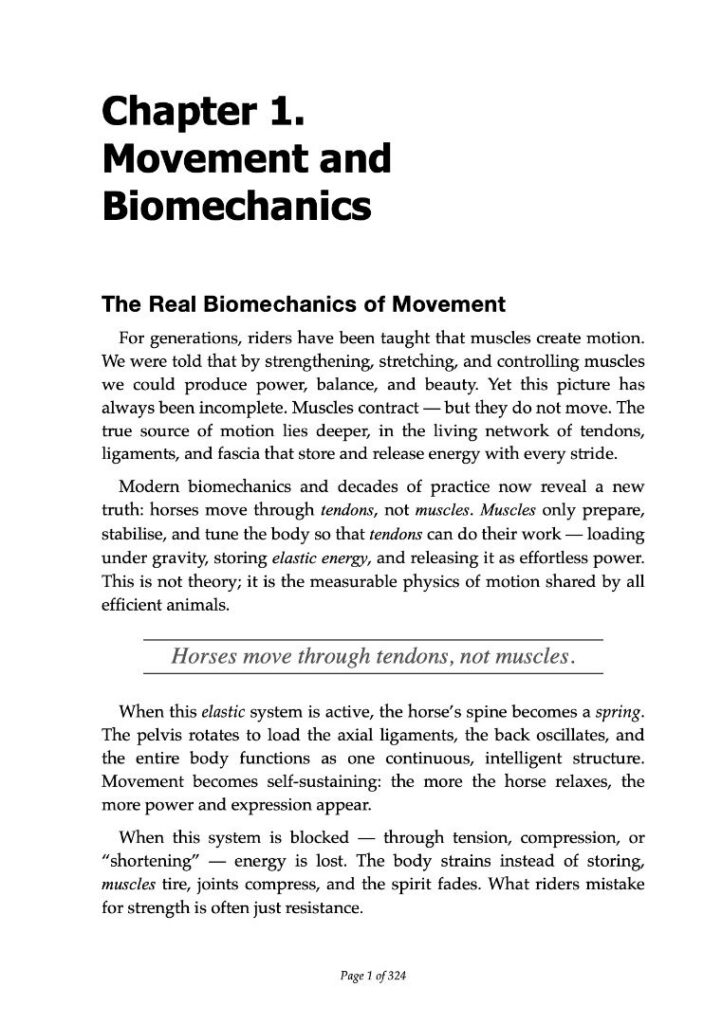
For more than 300-hundred years, equestrian theory has been built on one central assumption: the horse moves because muscles produce force. The hind legs push, the back transmits, the forehand receives. Strength, engagement, and collection are explained as products of push from behind.

That assumption is wrong.

Yet it has shaped how we train horses, how we judge them, how we breed them, how we select them, and eventually even how we train and ride them. It has shaped the entire language of equestrian sport. And yet it does not explain the reality of high-quality movement.

A truly efficient horse does not look like it is producing force over and over again. It looks like it is recycling energy.

This book introduces — for the first time in equestrian history — tendon-based movement as the central organizing principle of equine locomotion.

Tendon-based movement is not a refinement of the muscle model. It replaces it completely.

The horse is not primarily a muscular engine. It is an elastic system. The axial ligament chain from pelvis to poll is designed to store and release energy. Muscles provide brief tension; tendons and ligaments perform the majority of mechanical work. When this system is understood and trained deliberately, then the entire experience of movement both for the rider and for the horse changes completely.

This is not a cosmetic addition to existing knowledge. It is a complete shift in perspective.

It changes how horses should be started, how they should be developed, how collection should be built, how jumping should be approached, how contact should be understood, how breeding decisions should be evaluated, and how horses should be chosen when purchased.

No equestrian book before this has placed tendon-based movement at the center of biomechanics and training methodology.

The terminology itself — tendon-based movement — was created here. The framework was built here. The application to daily training, sport performance, and horse development has been developed and tested in real training practice here for the last 15 years.

Now, based on our know-how and hands-on experience we want to share with you the complete biomechanical training system in equestrian history built around the elastic principle of locomotion.

We are not adjusting vocabulary. We are redefining the foundation.

Locomotion is fundamentally elastic — not muscular — and a large part of what is currently accepted as correct training is mechanically wrong and must be redefined and ultimately changed.

This is why this book is not an addition to the existing model.

It is a revolution in how horse training will be approached and realised in the years to come.

The Contradictions Most Riders Eventually Face

If you have worked seriously with horses, you have likely experienced some of the following:

  • Horses become more muscled over time, but not lighter in the hand.

  • Horses show active hind leg, yet stiffen and drop in the back the moment collection is asked.

  • In canter topline flattens and back stiffens no matter how forward rider rides the horse.

  • In half-pass the horse travels sideways but the strides never feels spring-loaded, elastic and upwards.

  • In piaffe he horse lifts the legs but does not recycle energy, and gradually becomes tired and disengaged.

Within a muscle-dominant explanation, these are typically treated as insufficient engagement, insufficient impulsion, or insufficient strength.

Very often the problems with horses persist, because in many cases, the horse is not lacking what riders try to improve, that is: impulsion, strength or power.

Your horse is not lacking impulsion.

Your horse is not lacking engagement.

Your horse is not lacking strength.

The problems persist because the horse’s body is lacking elastic continuity.

The Missing Variable:
The Axial Elastic System

The horse is not primarily a muscular engine.

It is a longitudinal elastic system.

The axial ligament chain — from pelvis to poll — is the primary organizer of locomotion. It is not secondary support tissue. It is the central mechanical structure that stores, transfers, and returns energy through the entire body.

The limbs load it. The pelvis tensions it. The spine transmits it. The neck completes it.

When this system is free and functional, the back oscillates instead of stiffens. Energy travels instead of being produced locally. The stride sustains itself instead of being recreated through muscular effort.

When this system is blocked — at the pelvis, along the spine, or at the neck — muscles take over.

Compensation increases. Transmission decreases. Contact becomes heavy. Fatigue accelerates. What appears to be a strength problem is often a failure of elastic continuity.

The industry has treated muscles as the drivers of movement and ligaments as passive structures.

That is backwards.

Muscles regulate tension, but the axial elastic chain is what carries and transfers the load.

This is not stylistic preference.

It is the mechanical foundation of efficient locomotion.

Horse Training That Develops The Horse

The horse can move in two completely different modalities.

The first is muscle-based movement. In this modality, the muscles are directly moving the bones and therefore directly moving the body. The muscles remain active through most of the stride. The movement is driven by contraction. Horses moving this way often look strong, but the movement feels heavy, non-elastic, lacking rhythm and grace. They become dull in the contact, resistant in the back, difficult to unite from hind to front. The body feels fragmented, as if each part is working for itself rather than as a coordinated whole.

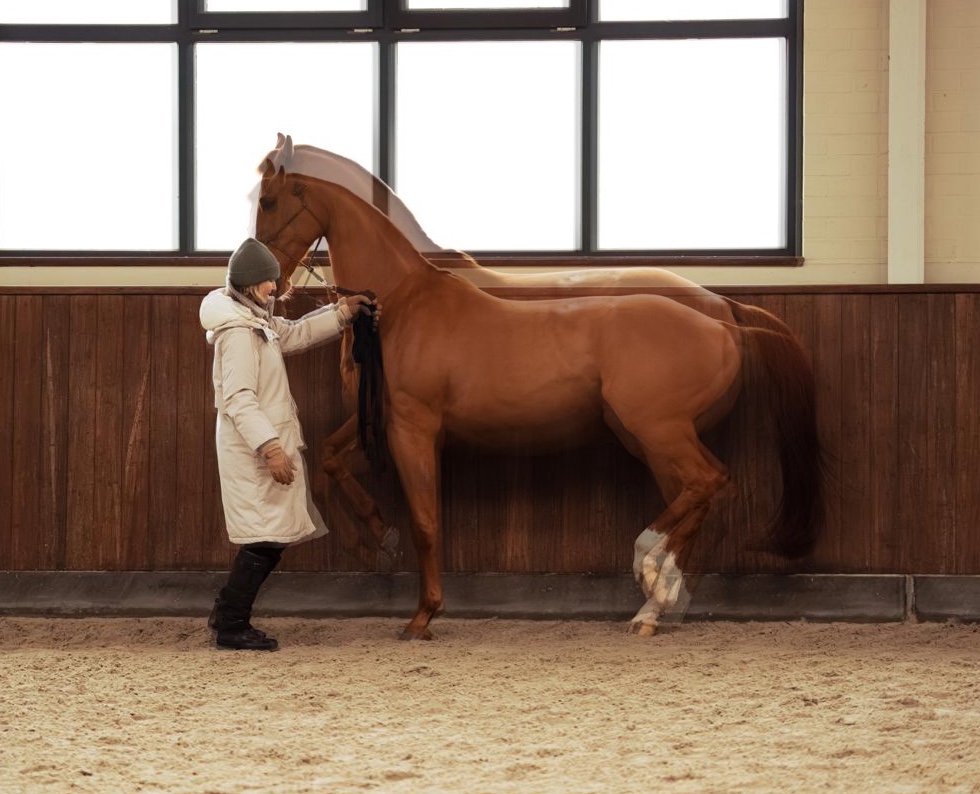
The second modality is tendon-based movement. In this modality, the muscles do not act as the primary engines. They provide short, precise tension to load the tendons and ligaments. The tendons then store energy and release it. The active element is the elastic system. Energy is reused rather than recreated from scratch in every stride. Horses moving in this way feel light, expressive, responsive. They seem to have remarkable stamina because they are not starting from zero with each movement; they are recycling energy through the axial ligament chain.

These two modalities are not stages on a spectrum. They are fundamentally different patterns of use.

If you train a horse in muscle-based movement, you are reinforcing muscle-based movement. The nervous system adapts to contraction-dominant patterns. The more you practice it, the more the horse relies on muscles to move and stabilize. You do not gradually develop tendon-based capacity by strengthening muscle-based work. You move further into the muscular pattern.

This is why spending years developing muscle-based movement is not neutral. It is counterproductive. It does not build the elastic ability required for high-level performance. In fact, it makes it harder to access.

In every equestrian discipline — dressage, jumping, eventing — what we ultimately want is tendon-based movement. A jump is a pure elastic action. Muscles alone are too slow and cannot generate the acceleration required; the horse must store and release energy through its tendons. The same applies to correct piaffe and passage. True expression and lightness come from elastic recoil, not from prolonged contraction.

If you are fortunate enough to own a horse that naturally prefers tendon-based movement and you do not suppress it, you may succeed without understanding why. But many horses default toward muscular patterns. Without conscious training toward elasticity, they will not develop tendon-based movement on their own, and with age and training will become stiffer, heavier, grumpier and gradually slower and less engaged.

Continuing to train in muscle-based modality while hoping for elastic results is a waste of time. It reinforces the wrong system and gradually makes the horse heavier, more tense, and more limited. Over time, this exposes the horse to fatigue, imbalance, and eventually injury.

The only way to truly develop the horse is to deliberately train in tendon-based movement.

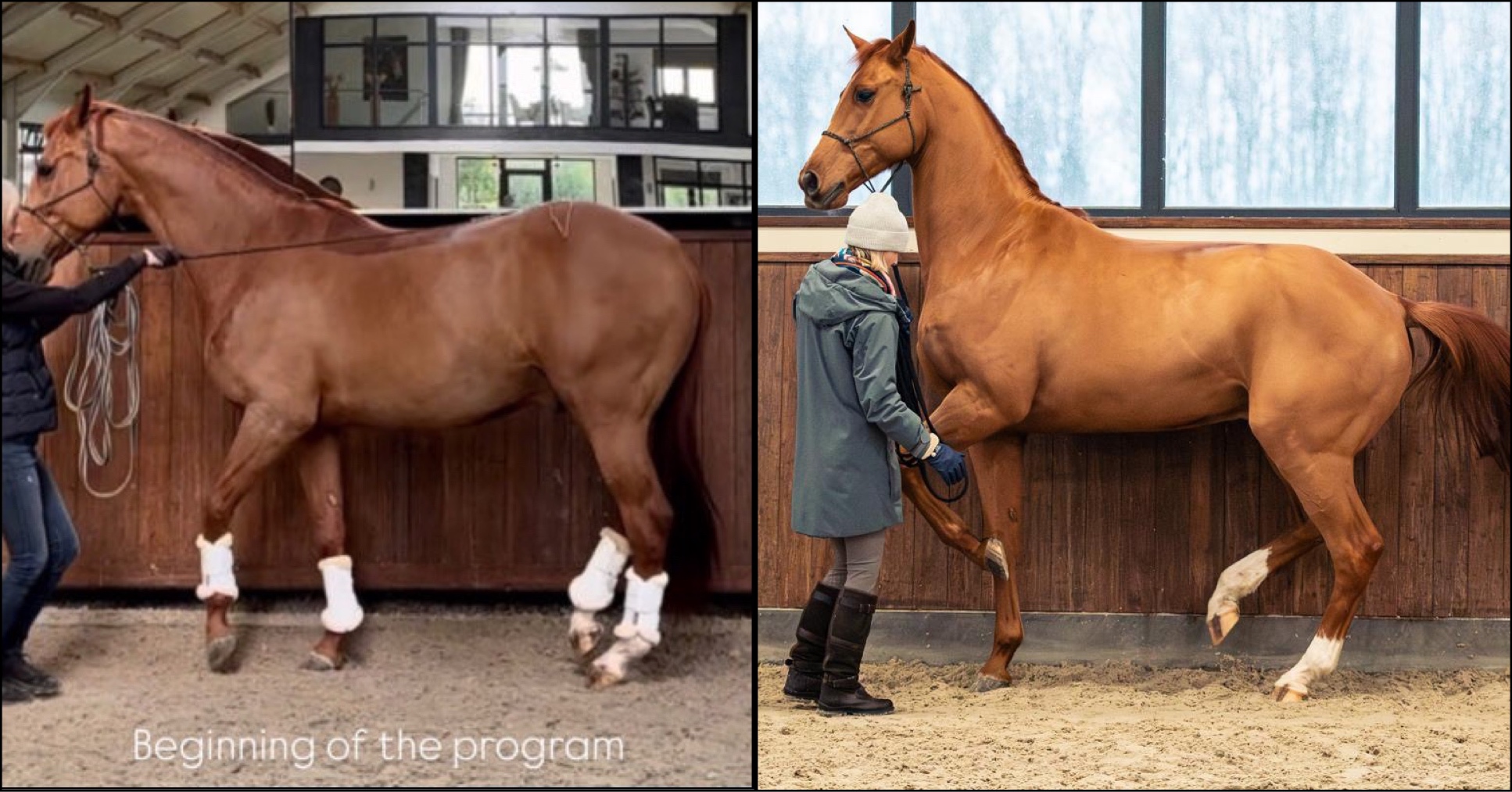
The good news is that for nearly every horse this transition is possible. When it happens, the change is unmistakable. Expression improves. Rhythm stabilizes. The horse becomes lighter yet more powerful. In jumping, the horse jumps higher. In dressage, movements gain suspension and clarity, all gaits improve dramatically. Stamina increases because energy is being reused rather than wasted.

Understanding tendon-based movement — and knowing how to apply it in everyday training — is the real beginning of development.

Remaining in muscle-based movement is not just inefficient. It gradually makes the horse worse.

Switching to tendon-based movement is the only conscious and constructive way forward.

Horse Training That Heals

Most riders believe muscles make the horse strong.

They believe that if they build more topline, more hind leg engagement, and more carrying power, the horse will become sounder and more supple. They believe fatigue, sweating or muscle heat means that the horse has worked correctly. They believe that if the back tightens under collection, the answer is more hand-elevation of the front and more impulsion and drive from behind.

But the truth is the opposite.

Movement is biology, not mechanics. The horse stays healthy only when motion circulates blood, lymph, oxygen, and fluid through its tissues. In correct locomotion, the tendons and ligaments carry most of the mechanical load. Muscles contract briefly to stretch the elastic structures, then relax while those structures rapidly release stored energy. During that relaxation phase, blood flows, waste is removed, oxygen returns, and the tissue regenerates. Every stride contains its own recovery.

When training is muscle-dominant, then this recovery disappears.

If muscles stay tense to hold posture, lift the back, or push the body, they compress their own capillaries. Blood flow drops. Oxygen drops. Acidity rises. Heat accumulates. The horse may look powerful, but inside it is burning fuel and building fatigue. Connective tissues dry, fascia thickens, ligaments lose elasticity, and the spine begins to compress. What looks like strength is often inflammation and compensation.

Tendon-based movement reverses this pattern completely.

In elastic locomotion, the pelvis rotates, the spine oscillates, and the long dorsal ligaments stretch and recoil. Mechanical energy is stored and returned instead of produced chemically by continuous contraction. Muscles work for a fraction of each stride and relax for the rest. That rhythm keeps tissues hydrated, joints lubricated, collagen aligned, and the nervous system calm. The horse does not accumulate fatigue — it regenerates while moving.

Healing does not happen by reducing work. It happens by restoring elastic function of the body.

When the axial ligament chain is free to work, we observe that the vertebrae decompress, fascia rehydrates, circulation improves, and coordination returns. Pain decreases not because the horse rests, but because compression is replaced by oscillation. Strength develops without bracing. Collection becomes elastic compression instead of muscular holding.

The belief that more effort creates soundness is the central error.

The biological reality is simple: elasticity heals, chronic muscular tension degrades. A horse trained through its tendons does not just perform — it continuously repairs itself with every stride.

Expressive Movement Is Designed to Be Both Powerful and Safe

There is a widespread belief in both jumping and dressage that a horse needs to be positively stressed, slightly excited, or close to explosion in order to be expressive. Energy is often confused with tension or excitement. Sharpness is mistaken for responsiveness and muscle contraction for power. Riders are told that brilliance comes from keeping the horse mentally and physically “up”, and “on the edge”.

Tendon-based movement shows the opposite.

True expression does not come from heightened muscular tension. It comes from elastic continuity. When the axial ligament chain is free and functioning, energy travels through the body in a coordinated wave. The pelvis rotates, the spine oscillates, and the neck completes the transmission. Nothing is blocked. Nothing is braced.

In this state, the nervous system does not need to defend the body. Muscles are not holding continuously. They contract briefly and release. Circulation improves. Recovery happens within each stride. The horse does not have to stay on edge to perform.

This is why horses moving in tendon-based modality often become calmer as they become more expressive.

The power is there, but it is organized. The suspension is there, but it is not explosive. The jump is higher, yet the body remains coordinated. The passage lifts, yet the back continues to oscillate, and the horse continues to breathe. Energy increases without agitation.

Muscle-based movement often creates the illusion that excitement produces brilliance. In reality, prolonged contraction reduces elastic transmission. The horse becomes louder in movement, heavier in contact, and mentally tighter.

Elastic movement produces a different quality of expression.

It is quiet power. It is rhythmic. It is balanced. It feels totally effortless. The horse does not need to be wound up to perform because the system itself is efficient. Expression and calmness are not opposites within tendon-based movement — they are consequences of the same elastic organization.

When energy flows through the ligament system instead of being forced through muscular contraction, the result is movement that is both expressive and stable.

That is calm expression.

Why This Book Was Necessary

Most equestrian anatomical knowledge originates from static dissection. In death, elastic tissues are no longer pre-tensioned. Ligaments and tendons appear passive. Muscles appear dominant.

In the living organism, the reality is different.

Modern in-vivo biomechanical research in human athletics demonstrates that tendons perform a large proportion of locomotor work. Muscles regulate stiffness and coordination — but elastic tissues carry long-range mechanical load.

The horse, as a cursorial athlete, is not an exception to elastic principles.

Yet equestrian literature has rarely treated the axial ligament system as the primary organizer of locomotion.

To my knowledge, this is the first comprehensive equestrian work devoted entirely to tendon-based biomechanics as the central framework of movement.

It does not refine the muscle-force model.

It moves beyond it.

Why I Wrote This Book

I wrote this book because I want your horse to move like the horse from your dreams — regardless of your budget, your background, or your starting point.

Whether your horse cost €1,000 or €500,000, the biology and biomechanics of efficient, beautiful movement are exactly the same. True quality of movement is not determined by price — it is determined by your ability to activate and nurture the right chains of activation.

This book is the result of years of my careful, systematic work — with my own horses and with hundreds of horses belonging to my clients. Horses who once moved with tension, limitation, or average quality gradually transformed under my guidance until they begun to float above the ground with ease, joy and engagement their riders only dreamed about before.

Through those years of refinement, and results, I developed a clear and repeatable system. And now, I am sharing it with you.

At the most accessible price in OneHorseLife history.

Because I want floating, effortless, self-sufficient, light, joyful movement to be available to every horse — and every rider who truly cares.

This book, together with the accompanying course, is my gift to you and your horse.

Why This Book Is Coming Out Now

For as long as I can remember, the way my horses move — and the way energy travels through their bodies under the saddle — has fascinated equestrians worldwide.

Their movement became the unmistakable signature of every horse trained within the OneHorseLife system.

Light. Elastic. Rebounding. Efficient. Engaged. Joyful. COMPLETELY EFFORTLESS.

Riders, trainers, breeders, horse owners — they kept asking the same question:

How do you create this?

Over the years, that curiosity grew into demand. In response to which, I developed two premium training programs dedicated entirely to this subject: From Walk to Piaffe, and W.E.A.K. Back Program. They go deep. They are transformative. And they deliver mind-blowing results.

But they are not accessible to everyone.

This book is my decision to change that.

It is a structured and comprehensive explanation of how these results are achieved — what within my training philosophy allows this quality of movement to emerge, and how it can be preserved, strengthened, and refined as the horse matures and progresses.

You will not only understand what tendon-based movement is.

You will understand how it is protected, cultivated, and reinforced in daily work.

And this is only the beginning.

The theoretical framework presented here in the Tendon Based Book will be supported by an ongoing, subscription-based training platform (OneHorseLifePLUS) dedicated entirely to developing Tendon-Based Movement in your horse. Think of them as two legs required to move forward: understanding and application. One without the other remains incomplete.

I deliberately chose to make this book highly accessible so that every serious horse owner — not only those with access to premium education — can begin working from a correct biomechanical foundation.

Tendon-based movement is not a luxury concept.

IT IS THE FUTURE OF HORSE TRAINING.

And it is a future your horse — and you — deserve.

What You Will Learn:

This book does not offer a collection of exercises (for practical training guidance, we are releasing OneHorseLifePLUS — a dedicated subscription platform focused entirely on developing Tendon-Based Movement in your horse, both from the ground and under saddle).

This Book offers a biomechanical lens that will fundamentally change how you interpret, evaluate, guide and influence your horse’s movement.

Once you see movement through this lens, you cannot unsee it.

And once you understand it, your training decisions will never be the same again.

You will learn to:

1.⁠ ⁠Distinguish Elastic From Muscular Movement

You will recognize:

  • When the spine is oscillating elastically rather than being stabilized through muscular co-contraction.

  • When hind limb activity is loading the axial chain rather than pushing independently.

  • When the neck functions as an anterior anchor of the spring rather than blocking transmission.

2.⁠ ⁠Identify the Real Source of Lost Engagement

You will understand why:

  • Increased hind leg activity or elevation does not restore connection if pelvic rotation is restricted.

  • Collection collapses when the horse's back length is contracted or reduced.

  • Heaviness or emptiness in contact often originates in disrupted ligament continuity rather than insufficient impulsion.

Instead of adding power or force to the system that is not functioning, you will restore its interconnectedness and elastic capacity.

3.⁠ ⁠Redefine “Working Over the Back”

Mechanically, this requires:

  • Adequate pelvic rotation

  • Sufficient spinal length for ligament strain

  • Continuous supraspinous transmission

  • Functional nuchal suspension

Without these, visible roundness is not function, it is mare compensation of the length of the spine that loses its ability to transfer energy forward. 

4.⁠ ⁠Recognize Early Warning Signs of Inefficiency

You will learn to identify:

  • Reduced oscillation before visible resistance appears

  • Asymmetrical axial loading behind apparent straightness

  • Neck fixation preceding back collapse

  • Muscular effort replacing elastic timing

This has direct implications for longevity and soundness.

Practical Training Consequences

Adopting an elastic framework changes daily decisions:
  • You restore pelvic rotation before increasing impulsion.
  • You maintain spinal length before compressing for collection.
  • You evaluate anterior suspension before correcting the forehand.
  • You interpret crookedness as asymmetrical axial loading, not simply limb placement.
  • You stop equating visible effort with correct work.

Instead of asking,
“How do I create more power?”

You begin asking,
“Is the elastic system free to store and return energy?”

That shift affects every transition, every half-pass, every collected stride.

How This Changes Horse Training and Riding

Understanding tendon-based movement does not simply add information. It changes perception.

When you begin to see the horse as an elastic system rather than a muscular engine, your priorities reorganize.

You no longer chase visible effort as proof of correctness.
You look for continuity of oscillation.
You listen for rebound instead of drive.
You assess whether energy is traveling through the body — or being absorbed and dissipated.

In practical terms, this alters how you approach:

WARM-UP: Instead of activating muscles first, you assess pelvic mobility and spinal length to ensure elastic readiness.

TRANSITIONS: You observe whether steps allow effective tendon loading and recoil, or whether muscular activation restricts limb compliance.

COLLECTION: You prioritise recoil timing and axial suspension before asking for greater carrying power.

CONTACT: Heaviness is a failure of elastic force transfer, not a contact issue.

STRAIGHTNESS: You analyze asymmetry as unequal loading of the axial chain, not merely uneven steps or strength in the push.

This framework does not only transform how you ride. It changes how you observe horses at liberty. You begin to distinguish which horses naturally recycle energy through elastic recoil — and which move primarily through muscular tension.

You learn to recognise subtle restrictions long before they manifest as visible resistance, injury, or fixed compensatory patterns.

Over time, this shift in perception leads to more economical training sessions.

Less unconscious driving.

Less manufacturing of power.

More finesse. More precision.

The rider’s role evolves — from generating movement to safeguarding the conditions under which elastic movement can emerge naturally and spontaneously.

This is not a stylistic refinement.

It is a fundamental shift in how you understand cause and effect in locomotion and your role in supporting it.

Proof in Practice

The principles described in this book are not theoretical abstractions.

They have been applied in practice across:
  • Young horses developing their skills under the saddle,
  • Advanced horses struggling with heaviness or loss of transmission,
  • Horses previously described as “strong but not through”,
  • Cases where muscular strengthening alone did not resolve imbalance, stiffness or blocked pelvis.

These are structural changes, not cosmetic adjustments.

Why This Matters Now

If locomotion is fundamentally elastic rather than muscular, then adding force to correct inefficiency often reinforces the very dysfunction we are trying to resolve. When we push harder to “fix” what is, in reality, an elastic failure, we unintentionally drive horses deeper into compensation.

And compensation always has a cost.

Continuing to train exclusively within a muscle-force framework does not only limit performance — it shortens careers, diminishes lightness, and slowly erodes the joy of movement.

This is not simply a technical distinction. It is a real welfare issue.

It is about whether we build horses that survive training — or horses that thrive within it.

Integrating elastic biomechanics is not an optional refinement for advanced riders.

It is a necessary evolution for every responsible horse owner in how they understand, protects and develop equine locomotion.

Because horses are not designed to move using muscle-based system. They are designed to recycle energy. To be loose and supple.

And when we honour that design, something extraordinary happens:

Performance improves.

Longevity increases.

Movement regains its lightness and joy.

This work is not only about creating prettier gaits.

It is about aligning training with the deep biological intelligence of the body of the horse.

And that alignment is no longer a luxury.

It is a responsibility. It is the future.

Why This Is a Crucial Stepping Stone for You

Whether you are a horse owner or a professional trainer, the framework you use determines the limits of your results.

If you continue to interpret locomotion primarily through muscular force, you will continue to solve problems with more effort, more activation, and more correction.

But if the primary limitation is elastic restriction rather than lack of strength, then force-based solutions will never fully resolve it.

This book represents a turning point in how you understand cause and effect in training.

For the horse owner, this knowledge allows you to:
  • Recognize early signs of mechanical inefficiency before they become resistance or unsoundness.
  • Make informed decisions about training intensity and progression.
  • Protect your horse from unnecessary muscular overuse.
  • Evaluate trainers and methods through a clearer biomechanical lens.

For the trainer, it changes the level at which you intervene:
  • You diagnose axial continuity before prescribing more engagement.
  • You distinguish strength deficits from elastic blockages.
  • You prevent rather than correct long-term imbalance.
  • You elevate your practice from technique-driven to structure-driven training.

The industry is gradually moving toward more refined biomechanical understanding. Elastic locomotion theory is not a trend — it is a structural reality.

Understanding it now places you ahead of outdated force-based interpretations.

Ignoring it means continuing to work within a partial model of how the horse actually moves.

This book is not simply additional knowledge. It is a foundation for more precise, more sustainable training in the years ahead.

Why This Gives You an Edge

Tendon-based movement is expressive, economical, agile, rhythmic. It produces exactly what every discipline is searching for — lightness in dressage, scope in jumping, adjustability in eventing, stamina everywhere.

The paradox is simple: most trainers, riders, and horse owners already want tendon-based movement. They just do not know what it is.

They look at the outside picture. They admire suspension, freedom of the shoulder, uphill balance, bascule over a fence. They try to create those qualities through more engagement, more power, more visible effort — without understanding the internal biomechanical difference between a horse moving through muscles and a horse moving through tendons.

Many owners even select horses who naturally prefer tendon-based movement — without being able to identify why those horses feel different.

When you understand the internal difference, everything changes.

You see what others cannot see. You recognize whether the spine is transmitting elastic energy or whether muscles are compensating. You understand whether power is being recycled or recreated through contraction. You know how to deliberately develop the elastic system instead of hoping it appears.

That is the real edge.

It is not a trick. It is not a technique. It is structural clarity.

While others vaguely chase a picture, you understand the mechanism behind it. While others add more force, you refine the elastic system. While others admire talent, you know how to build it.

This immediately places you at a different level as a rider and trainer — not because you are doing more, but because you are working with the correct biomechanical foundation.

Why Starting Now
Places You Years Ahead

Most trainers today have no knowledge of tendon-based movement.

They focus on what they see from the outside — expression, power, activity, engagement — and they design their training sessions based on assumptions that are mechanically incorrect. They are building on a wrong understanding of how the horse actually moves.

Because of that, they rarely reach the level of result that is fully possible.

When you understand the real biomechanics of the horse — when you understand the difference between muscle-based and tendon-based movement — you are operating on a completely different level.

That alone places you years ahead.

This is not theoretical advantage. It is practical advantage. The principles in this book have been applied and tested in real training over the past years before publication. The results are outstanding. Horses become lighter, more expressive, more durable, more capable. Performance improves because the mechanical foundation is correct.

Tendon-based movement is a new discipline. It begins with the publication of this book. It will take years for the broader industry to absorb, understand, and integrate this knowledge. There will be resistance. There will be misunderstanding. There will be slow adoption.

Those who understand it first — and apply it first — will have a structural advantage over others who are still training within muscle-dominant assumptions.

Because they are working from a correct model of locomotion.

Who This Book Is For

This book is written for people who care deeply about how horses actually move — and who are ready to question the explanations they have been given.

For the Dressage Rider

If you ride dressage, you were likely taught that greater collection comes from increased engagement and carrying power. You may believe that if the horse loses lift in the back, you must create more activity behind.

After reading this book, that belief shifts.

You begin to see that many problems in collection are not strength deficits, but failures of elastic storage and recoil. Instead of adding drive, you restore spinal length and pelvic rotation first. Collection stops being manufactured and begins to feel like compressed spring energy.

For the Show Jumper

If you ride jumping horses, you may believe that scope and bascule are primarily products of power and technique. When the jump feels flat, the instinct is often to add more impulsion.

After understanding tendon-based movement, you recognize that take-off depends on elastic recoil, not muscular push alone. A blocked axial chain limits lift regardless of strength. By restoring elastic continuity, the jump becomes rounder and more economical — not because you drove harder, but because the spring system was free to load and release.

For the Event Rider

If you compete in eventing, you balance endurance, adjustability, and precision. You may believe that conditioning and strength are the primary safeguards for performance across phases.

This book reframes durability.

Elastic efficiency reduces metabolic cost and muscular overuse. Horses that recycle energy fatigue less and maintain better balance late in the course. Instead of training only for fitness, you begin training for mechanical economy — which directly influences soundness and longevity.

For the Young Horse Trainer

If you develop young horses, you may believe that teaching them to “sit” and accept contact early establishes correct foundations.

After reading this book, you look first for oscillation before compression.

A young horse that learns to stabilize through muscle before developing elastic timing builds tension patterns that are difficult to undo. When you prioritize spinal length and pelvic mobility first, strength develops on top of elasticity rather than replacing it.

For the General Horse Owner

If you are a dedicated horse owner — whether you ride recreationally, train at home, or work with a local instructor — you may believe that resistance, heaviness, or stiffness are behavioral or training-discipline issues.

This book changes how you interpret everyday struggles.

Instead of seeing your horse as unwilling or insufficiently trained, you begin to ask whether elastic transmission is interrupted. You learn to recognize early signs of axial restriction before they escalate into larger problems. This alone can prevent months — sometimes years — of unnecessary correction.

For Equestrian Professionals Across Disciplines

Regardless of discipline, many professionals operate within a muscle-dominant model because that is the language inherited from tradition.

This book offers a structural upgrade.

When you understand locomotion as elastic management rather than force production, you intervene earlier, more precisely, and with less escalation. You distinguish strength deficits from elastic blockages. You stop solving transmission problems with more activation.

The result is more accurate training.

If you work with horses seriously — whether in dressage, jumping, eventing, young horse development, or everyday riding — this framework challenges and changes what you see, what you prioritise, and what you want to correct in your training.

It replaces a partial model with a more complete one. And that shift has consequences in every stride your horse takes.

The Central Question

Is the horse generating force in every stride? Or is it regulating elastic energy within a pre-tensioned biological spring system?

This is not an academic question.

It is the line that divides two eras of training.

If you believe locomotion is result of power and effort, you will add strength to solve inefficiency. And over time, you will also manufacture tension, compensation, and breakdown.

If you understand locomotion as elastic energy management, then everything changes.

You begin to protect recoil instead of replacing it. You will develop collection through timing and alignment — not through power and effort.

The difference is not subtle.

It determines performance.
It determines longevity.
It determines whether a horse survives training — or flourishes within it.

Tendon-Based Movement is not a technique.

It is a structural re-orientation of how we interpret cause and effect in equine locomotion.

It is the shift from a muscle-dominant paradigm to an elasticity-led understanding.

Clarity in biomechanics creates clarity in action.

And clarity — consistently applied — reshapes outcomes.

Not only in how horses move.

But in how they feel while moving.

This is not refinement.

It is a true revolution.

Why This Work Cannot Wait

Tendon-based movement changes everything.

Once you truly understand the difference between muscle-based movement and tendon-based movement — and once you know how to train a horse in the tendon-based modality — your entire position as a rider and trainer changes. You are no longer guessing. You are no longer trying to fix symptoms with more effort. You are working with the real biomechanics of movement.

That makes you powerful in the best possible way.

You can start developing your horse to move better, jump higher, and express itself with real elasticity. You can build stamina because the horse is reusing energy instead of starting from zero in every stride. You can keep the rhythm under saddle because the movement is traveling through the whole body instead of breaking apart.

These abilities often look like “talent” or something reserved for elite trainers. In reality, they come from understanding how the horse is truly built to move.

At the same time, this knowledge allows you to support your horse’s health in a deeper way. When movement becomes elastic instead of muscular, the body works with less internal strain. The horse does not have to fight itself in every stride. That supports longevity. That supports durability. That supports a longer, more enjoyable partnership.

Older horses are not automatically limited by age. Many are limited by how they were trained. When they begin to move in a tendon-based way, you can often enjoy riding together — and even competing together — much longer than you expect.

This opens completely new possibilities.

Better movement. Better performance. Better health. More years together.

Understanding tendon-based movement — and applying it consciously in everyday training — is the real beginning of developing a horse.

Everything changes from there.

JOIN THE REVOLUTION

Tendon-Based Movement

Original price was: kr537.68.Current price is: kr406.00.
Select your currency